

Sovereign, resilient security for enterprises and critical infrastructure.
Daksario is a cyber security consulting practice built for modern enterprises operating in complex, regulated, and high-threat environments.
Cyber risk today is no longer limited to data theft. It includes:
ransomware-driven downtime
identity compromise and privileged abuse
supply chain and third-party exposure
cloud security misconfiguration
insecure AI adoption and data leakage
OT and cyber-physical threats
Daksario helps organizations design and implement cyber programs that protect business-critical systems and enable secure growth. Our team brings deep experience across Big 5 consulting, finance, healthcare, and large-scale enterprise transformation programs.
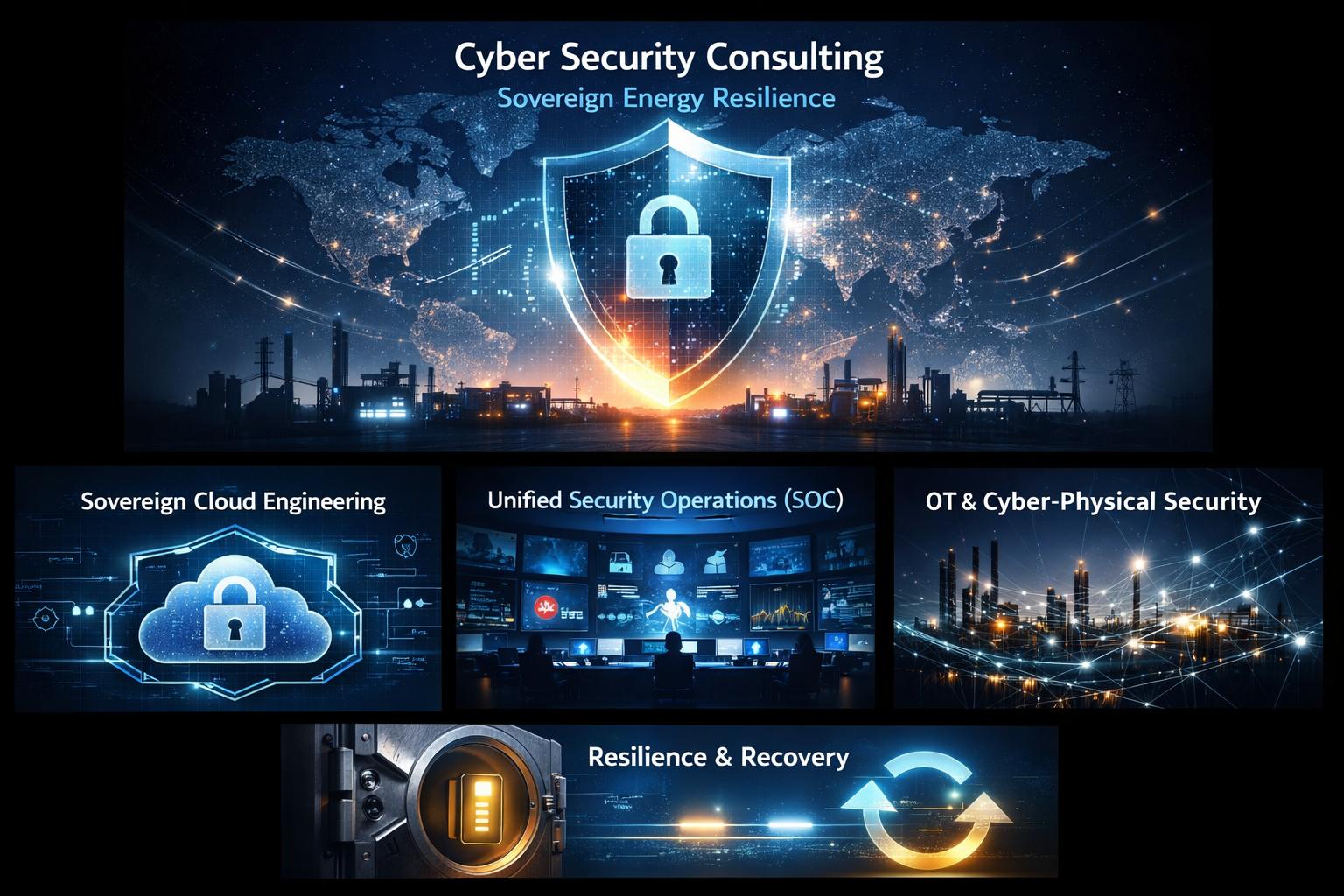
Core Capabilities
Cyber-Physical SOC + OT Resilience for Refineries, Pipelines & Remote Assets
Merging IT/OT Security with Physical Perimeter Intelligence to Protect Continuity
Challenge
Energy infrastructure security extends beyond IT. Many operators face:
fragmented monitoring between IT SOC, OT engineering teams, and physical security groups
increased insider risk and remote site exposure (pipelines, compressor stations, substations)
OT environments with legacy devices that can’t tolerate active scanning
lack of tested continuity plans if systems are disrupted (screens dark, SCADA impacted, ransomware events)
Daksario Engagement
Daksario implemented a converged defense and resilience program to merge visibility + response + safe recovery across cyber and physical domains.
Key Workstreams Delivered
Unified Cyber-Physical SOC (U-SOC)
Correlation & Verification Controls
Industrial Asset Discovery (Passive Monitoring)
Black Start & Safe Restart Planning
Outcomes
Unified real-time visibility across cyber + OT + physical security
Improved detection quality and reduced false positives through cross-domain validation
Identified undocumented devices and pathways increasing OT risk exposure
Increased continuity readiness with tested recovery procedures designed for industrial safety and operational stability
Reduced incident response friction by aligning IT, engineering, and physical security workflows
Sovereign Cloud Security & AI Custodianship for Energy Operations
Building an “On-Soil” Architecture to Protect National Energy Intelligence
Challenge
Energy-sector operators increasingly rely on cloud platforms for monitoring, analytics, and AI-enabled optimization. This creates strategic risk when critical operational intelligence becomes dependent on foreign infrastructure, including:
cloud-hosted logs and telemetry pipelines outside sovereign control
limited visibility into where operational datasets are stored or processed
encryption models where the provider retains decryption capability
increasing exposure of sensitive data (reservoir metadata, production forecasts, trading intelligence, operational models)
Daksario Engagement
Daksario executed a sovereign security modernization program focused on data custodianship and AI sovereignty.
Key Workstreams Delivered
Sovereign Cloud Engineering
Designed and deployed a private “on-soil” cloud architecture (Azure Local / private cloud) to ensure critical telemetry and datasets remain within national borders.Sovereign Logging & Monitoring Architecture
Implemented controlled pipelines for system logs, SOC telemetry, and operational data ingestion—ensuring evidence, audit trails, and observability remain local.HYOK Encryption & Key Management
Designed a Hold-Your-Own-Key (HYOK) approach where encryption keys are controlled by the operator (HSM-backed), preventing cloud providers from decrypting sensitive assets.On-Premise Generative AI (Local LLMs)
Enabled secure local-LLM deployment patterns for restricted environments and air-gapped use cases, ensuring proprietary intelligence never touches global services.
Outcomes
Achieved sovereign custody of operational data, telemetry, and encryption keys
Reduced strategic and geopolitical exposure by eliminating dependency on global decryption pathways
Established an architecture foundation for secure AI adoption (LLMOps / Local-LLM patterns)
Enabled security governance and audit readiness aligned to national critical infrastructure standards